

Performance Anxiety Part 3 - Why We Get Nervous Before Breaking Battles and How to Handle It
"The pressure of competition can pep up and improve an individual's performance or damage it. For most of us, competition is associated with feeling alert and ready, yet we may also experience apprehension, sweating palms or worry about how we will perform. If we can find out why this happens, how we can prevent the ill-effects and harness the positive aspects, then we should be able to improve performance." (Woods, 1998)
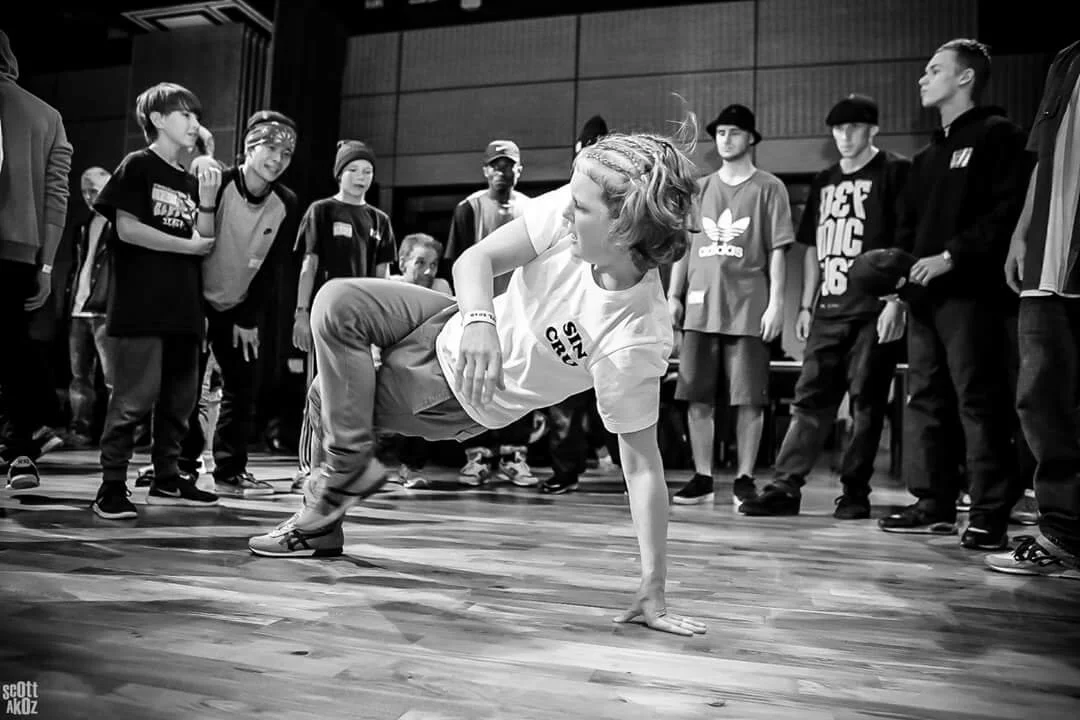
Photo by Scott Akoz Photography
When I was researching this topic I wanted to learn strategies for controlling anxiety prior to breaking competitions, and to be able to pass these strategies onto my students and peers. I examined areas of Sport Psychology covering breathing techniques and interviews with athletes in relation to performance anxiety, and I applied theories from these areas to the analysis of performance anxiety in relation to breaking.
"The pressure of competition can pep up and improve an individual's performance or damage it. For most of us, competition is associated with feeling alert and ready, yet we may also experience apprehension, sweating palms or worry about how we will perform. If we can find out why this happens, how we can prevent the ill-effects and harness the positive aspects, then we should be able to improve performance." (Woods, 1998)
This quote sums up the paradoxical nature of the effects of pressure of competition. On one hand it adds an edge to athletes' performances, sharpening their responses, and on the other it induces feelings of anxiety which could hinder performance.
I decided to research Sports Psychology even though I was investigating performance anxiety from the perspective of a dance form. The similarities of training physical techniques and preparing for competitions between sport and breaking led me to believe I would find useful information in the field of Sport Psychology that could be applied to competitive breaking situations.
The Sport Psychologist, Richard H. Cox, states that he is interested in helping athletes reach their potential, and does this by developing their self-control and confidence. He believes that Sport Psychology is
"dedicated to the enhancement of both athletic performance and the social-psychological aspects of human enrichment." (Cox, R. p.4, 1998).
That is, athletes can have a rewarding sporting experience without winning, and that this experience increases their internal motivation to continue to strive to reach their potential. I also believe this to be true. In breaking competitions, dancers can feel fulfilled and rewarded if they perform well, even though they do not win the competition. The experience of reaching a personal goal can motivate them to perform better next time they enter a competition. Sometimes, the audience's favourite dancer is not the winner, but the one who gave the best performance.
One area I was interested in exploring in relation to performance anxiety was breathing technique. Working with breath is very important in breaking, especially when the dancer is on stage under hot lights with a large crowd spectating. Breaking is performed in short, fast bursts, like sprinting, so utilising breathing techniques is essential for the correct execution of moves, but it also is useful for alleviating stress and anxiety in performance situations.
In the book Sport Psychology, Concepts and Applications, Cox discusses his work with a golfer who had been the leading amateur in Scotland but whose skills had levelled off once he started competing professionally. Cox espouses a Behaviourist philosophy (Skinner, 1974). Cox explains Behaviourism as the study of the mind and body as a complete entity, in which thoughts, feelings, actions and words spoken are all forms of behaviour which can be studied. Cognitive behaviour can be studied through verbal behaviour, and emotional behaviour through how and when speech and actions occur in an individual. Cox believes that an athlete's problems can be solved through Behaviour Modification (Martin and Pears, 1992). Behaviour Modification states that behavioural problems can be measured, and that the individual's environment can be rearranged to help the individual function more effectively in that environment. Specific interventions can produce changes in behaviour.
One intervention that Cox looked at which I found relevant to my research was that of a golfer with whom he applied breathing techniques. He asked the golfer to modify his breathing at the moment of striking the ball, to concentrate on breathing out instead of holding his breath or inhaling at this specific time. Cox's intention here was to reduce the golfer's muscle tension in his chest, jaw and shoulders so that he would have more control over his swing. Another benefit of concentrating on breathing out at this particular time was that the golfer would feel like this was an easy behaviour modification that he could control, instead of feeling as though he was being controlled by external factors.
In a breaking competition, being able to control certain internal factors is an advantage. There are many external factors that the dancer is not in control of: the music the DJ plays, the temperature of the room, when the dancer has to take their turn on the dance floor, who the dancer has to compete against. In light of this, to concentrate on internal factors that are within the dancer's control will lead to the dancer achieving a more relaxed state. The breathing techniques Cox uses with the golfer can be transposed to breaking, with similar positive results. The dancer can focus on breathing out when executing a particular move for example. There are, however, many other ways breathing techniques can be employed in breaking. The dancer can focus on breathing in and out in time with the music, thereby ensuring their body is moving in time with the rhythm, and lessening the stress of having to stay on beat. The dancer can use breathing exercises to lower muscle tension before the competition begins, inhaling for a count of 4, holding the breath for another count of 4 then exhaling for a count of 8. This also takes the dancer's focus away from their nerves and the stressful external stimuli as they are concentrating only on breathing, an internal focus.
Another behaviour modification Cox employs with the golfer is visualisation. He asks the golfer to visualise where he wants the ball to land before he hits it. This is to reinforce a positive thought pattern rather than negative self-instruction which the golfer had previously undertaken. This modification was also designed to take the focus away from external stimuli which were causing the golfer anxiety, and to focus instead on internal stimuli. This is useful in terms of breaking competitions too, as it is easy for the dancer to become distracted by what that is happening in their environment. Breaking competitions, however, are viewed as 'conversations' between the opponents. The dancer who takes the first turn sets the tone of the conversation, and the next dancer replies or attempts to change the tone. The dancer, therefore, cannot completely focus on internal stimuli, as they must be aware of their opponent's behaviour and engage with and respond to it. Focusing on internal stimuli is an effective tool prior to the competition, but once the competition begins the dancer must be able to share focus with external and internal stimuli. As Butler (1997) states, what separates top level athletes, or dancers in this case, is the "ability to focus their attention, at precisely the right moment, on the most relevant stimuli concerning performance." Once this skill has been mastered, performance anxiety will be lessened.
Strategies for dancers can be to find a quiet place to perform their breathing exercises before the competition, and to learn how to focus on internal stimuli when surrounded by a busy, noisy environment. This is something that I try to do on the day of a competition. I find the atmosphere of the room, the loud music and the behaviour of the other competitors distracting, and finding a quiet place in the venue to focus on myself and my breathing helps me relax.
Two theories I researched are Drive Theory (Hull, 1951) and Inverted U Theory (Yerkes and Dobson, 1908). Both of these theories are connected to arousal. Woods (1998) defines arousal as a neutral state that is experienced as anxiety when connected to negative thoughts and feelings. She states that anxiety occurs when we encounter an experience that we believe we are unable to deal with. This is also referred to as Distress in the literature. Distress is negative stress that causes anxiety. It can decrease performance, feel unpleasant and lead to physical symptoms such as sweating and shaking, butterflies and raised heartbeat. Contrary to this, Eustress is positive stress. It is short term, feels like excitement and is useful for motivation and concentration. We experience Eustress when we encounter an experience that we believe we are able to deal with. The deciding factor that appears to affect whether a dancer is negatively or positively stressed is control: if the dancer feels in control he can utilise his stress hormones effectively.
(http://www.gulfbend.org/poc/view_doc.php?type=doc&id=15644&cn=117)
Although Drive Theory and Inverted U Theory agree that arousal affects performance, they disagree on how. Drive Theory states that the more arousal an individual experiences the better their performance will be, while Inverted U Theory states that there is an optimal level of arousal for optimal performance and if arousal rises above or falls below this level, performance will decline. I agree that there is an optimal arousal rate for performance. If I feel too nervous or excited, or if I feel too tired or bored, I do not perform well. Learning how to achieve the optimal arousal level is key for good performance.
Further, Martens, Vealey and Burton (1990) believe there are three components to anxiety:
Cognitive State Anxiety
Somatic State Anxiety
Self-Confidence
Cognitive State Anxiety comprises worry, negative thoughts about performance, fear of failure, disrupted attention and an inability to concentrate. Somatic State Anxiety comprises physical symptoms e.g. sweating and butterflies. Self-Confidence comprises expectations of failure or success. I have experienced all of these components in a competition situation, and I feel that by implementing the strategies of internal focus and breath, these feelings are alleviated.
Drive Theory states that when an athlete is learning a new skill, their dominant physical responses are often instinctively incorrect, and are corrected through rigorous practice of the correct response. As they build up skills, their physical responses become more accurate. This theory espouses that skilled athletes make the correct physical response most of the time when they experience arousal during a competition. In breaking, when a dancer's physical response is incorrect, they are said to have 'poor form', or if they do not correctly execute a move that they have 'crashed'. Practice and training allows the dancer to learn the correct dominant response and go on to perform well when experiencing the arousal of competition.
Inverted U Theory states that increase of arousal leads to increase of performance, but only up to a certain critical point. When arousal levels are too low or too high, performance decreases. At the optimal arousal level, focus is direct and accurate decisions can be made. Once passed this level, anxiety can set in. Too much or too little causes anxiety according to this theory. Anxiety leads to poor decision making and low focus, there is a narrow field of concentration and the physical symptoms appear.
If a dancer can recognise signs of physical stress they can take measures to counteract these signs. Breathing exercises can lower anxiety and relax muscle tension, focusing on internal rather than external stimuli can ensure they are not distracted by what is going on in their environment. Visualisation exercises can ensure that they are not overwhelmed by negative thoughts. Muscle relaxation exercises can also reduce tension, for example by tensing and holding each muscle then releasing, starting from the toes and finishing at the head. These are all strategies that are useful in decreasing performance anxiety before and during a breaking competition.
Another theory I researched was Achievement Motivation (Atkinson, 1964). Woods (1998) discusses this theory, and describes the difference between having a high motive to achieve success and a high motive to avoid failure.
People with a high motive to achieve actively look for challenges, they want to perform at a high standard, they persist in trying to achieve their goals, they value feedback from others and enjoy performing in situations where they can be evaluated. People with high motive to achieve are not afraid of failure and attribute their performance to internal factors over external ones. They recognise that they may fail if they do not put in enough effort or if they do not concentrate hard enough.
These attributes can be viewed in a breaking competition situation as a dancer who looks for competitions to enter, prepares well in order to perform at a high standard, keeps trying even when they feel as though they are losing, asks judges and peers for feedback and enjoys competing in front of those people for that reason. They are not afraid to lose, and attribute winning to internal factors. Having a high motive to achieve is a positive attribute in relation to breaking competitions.
Conversely, people with a high motive to avoid failure tend to avoid challenges, preferring to compete against easy opposition so they are guaranteed success, or very difficult opposition, guaranteeing failure which is not their fault. They also tend to be preoccupied with failure, and dislike situations where they can be evaluated. Evaluation here is linked with shame of failure, and as such they perform to a lower standard when they are being evaluated. They attribute their performance to external rather than internal factors.
This can be related to breakers who avoid entering competitions or enter competitions with very low or very high level dancers, breakers who perform badly when judges and peers are watching, and attribute performance to external factors (bad floor, poor decision making by judges, the level of other dancers was too high/low). If a dancer does not naturally have a high motive to achieve, perhaps positive self talk would help instil this quality. This could be factored into their everyday training, so that when it comes time to compete, they will be ready to display these positive attributes in a stressful situation.
In conclusion, I feel that I have learned some useful strategies for controlling performance anxiety prior to and during breaking competitions. Breathing exercises, focusing on internal rather than external stimuli, focus and concentration directed to the right place at the right time, visualisation, consistent training and establishing a high motive to achieve over a high motive to avoid failure. I have experimented with each of these techniques in competitions I have entered. I have learned that goal setting is critical for me in order to engage my competitive nature in breaking competitions. I prefer to compete in less formal atmospheres, where there are no judges or time limits. Perhaps this shows that I err on the side of having a high motive to avoid failure as I don't like to be evaluated by judges in a stressful, more formal situation. In future, I can work on positive self talk to change this to a high motive to achieve. Breathing exercises help to keep the physical symptoms of anxiety at bay, and I now utilise these exercises before every round in a competition. I find it useful to focus on internal stimuli immediately before a competition, it focuses my mind onto the performance, rather than worrying about the outcome. I think that if I bring this into my regular training sessions, I will be more prepared for the stress of competitions.
References
Anon. The Mind Body Problem with Tennis Champion Janko Tipsarevic. Available at: https://rcs.kanopystreaming.com/video/mind-body-problem [Accessed 7/11/2016]
Atkinson, J. W. (1964) An Introduction to Motivation. Princeton, N.J.: Nostrand
Butler, R (1997), Sports Psychology in Performance, Arnold
Cox, R.H. (1993) Sport psychology: Concepts and applications. 3rd edn. Madison, WI: Brown & Benchmark Publishers.
Gulf Blend Centre, http://www.gulfbend.org/poc/view_doc.php?type=doc&id=15644&cn=117 [Accessed 18/06/2017]
Hull, C. L. (1951) Essentials of Behaviour. New Haven: Yale University Press
Martens, R., Vealey, R. S., Burton, D. (1990) Competitive Anxiety in Sport. Leeds: Human Kinetics Books.
Skinner, B. F. (1974) About Behaviourism. London: Cape
Woods, B. (1998). Applying Psychology to Sport. London: Hodder & Stoughton
Yerkes RM, Dodson JD (1908). "The relation of strength of stimulus to rapidity of habit-formation". Journal of Comparative Neurology and Psychology. 18: 459–482. doi:10.1002/cne.920180503.

Performance Anxiety Part 2 - How Does Motivation Affect Anxiety in Breaking Battles?
When I was studying Learning and Teaching in the Performing Arts at The Royal Conservatoire of Scotland, I undertook a project to learn about performance anxiety and investigate what strategies breakers can implement for controlling anxiety prior to competitions. This blog is part 2 of my literature review from that project.

When I was studying Learning and Teaching in the Performing Arts at The Royal Conservatoire of Scotland, I undertook a project to learn about performance anxiety and investigate what strategies breakers can implement for controlling anxiety prior to competitions. This blog is part 2 of my literature review from that project.
Motivation and How it Affects Performance Anxiety
Nieminen et al (p 176 2001) discuss achievement motivation in regards to performance anxiety, commenting on the similarities of sport and dance disciplines, “Dance and sport share many common physical, psychological and social elements such as skills, strength, flexibility, achievement, self-confidence, competition and friendship.” They describe two types of motivation orientation in terms of how individuals perceive success and failure. Task-oriented individuals focus on acquiring and mastering skills, and feel successful when they focus on personal improvement and learning. Ego-oriented individuals focus on being the best and feel successful when outperforming others. These variations in motivation relate to behaviour and perceived competence, which in turn affect how performance anxiety is experienced.
Andrzejewski et al (2013) describe goal orientation theory in relation to dancers. In this theory, mastery-goal orientation is akin to task-orientation, where learning is viewed as valuable in itself, and gaining new skills and understanding is favoured. Performance-goal orientation is akin to ego-orientation, where learning is a means to outdo peers and focus is placed on demonstrating competence to others.
Lazaroff (2001) describes these orientations within the dance world as intrinsic and extrinsic motivation. Intrinsic motivation is the tendency to engage in an activity for enjoyment and feelings of accomplishment without an external reward, providing motivation for dancers to continue to invest effort in their training. Extrinsic motivation is the tendency to engage in an activity as a means to an end, where praise and positive feedback are the motivation.
Aoyagi (2013) states that athletes’ sense-of-self is at the core of intrinsic motivation. Any real or perceived threat to the sense-of-self will affect motivation which will in turn affect performance. He states that “Intrinsic motivation influences athletes’ belief in their ability, which affects their trust in this ability, determining the ability to be confident in the moment and switch into automatic processing…” (p 150, Aoyagi, 2013).
Carson and Collins (2016) define automaticity as attention being focused on high-order aspects of skill execution instead of movement components. This reduces the number of steps required to retrieve a skill from long-term memory. Performance anxiety causes the performer to focus on lower-order aspects, the step-by-step motions of skill execution, so automaticity is disrupted by anxiety. This conscious processing of a skill in a performance situation that can be executed automatically in a non-performance situation is referred to as self-focus theory. This theory posits that high pressure situations result in feelings of anxiety, self-consciousness and worry about performing well.
Hays et al (2009) discuss the importance of self-confidence in world class sports performance in terms of the Integrated Model of Sport Confidence (Vealey, 2001). They state that confident athletes are effective at using the necessary cognitive resources for a successful performance, they are task-diagnostic instead of self-diagnostic, looking for solutions to unforeseen problems rather than questioning their ability to deal with them. This belief in their ability allows them to peak under pressure and cope with adverse situations during competition. They also discuss perception of anxiety symptoms. Confident athletes perceive symptoms positively, as excitement, whereas athletes with low confidence perceive the same symptoms negatively, as worry, panic and fear. Athletes’ level of confidence is influenced by their thoughts, feelings and behaviours, which in turn affect their performance. Perhaps the higher the self-confidence, the more the individual can tune into automaticity.
Performance anxiety disrupts performance, hinders career advancement and threatens self-esteem, identity and confidence. Employing psychological skills to control it can improve all these factors. Setting goals, using imagery, meditation and mindfulness, maintaining motivation during training, increasing confidence and reducing feelings of isolation by talking to peers can all help to regulate negative thoughts, reducing performance anxiety and producing a more focused, confident individual. Changing focus and being able to perceive symptoms of anxiety as excitement rather than worry helps reduce fear. Adopting a mastery-goal orientation during training periods and switching to a performance-goal orientation during competitions would also be beneficial. These are all useful strategies that the field of breaking would benefit from.
References
Andrzejewski, C.E., Wilson, A. M., & Henry, D. J., (2013) Considering motivation, goals, and mastery orientation in dance technique, Research in Dance Education, 14:2, 162-175, DOI: 10.1080/14647893.2012.733364 https://doi.org/10.1080/14647893.2012.733364
Aoyagi, M. W., (2013) Teaching Theories of Performance Excellence to Sport & Performance Psychology Consultants-in-Training, Journal of Sport Psychology in Action, 4:3, 139-151, DOI: 10.1080/21520704.2013.792895 https://doi.org/10.1080/21520704.2013.792895
Carson, H. J., & Collins, D., (2016) The fourth dimension: A motoric perspective on the anxiety–performance relationship, International Review of Sport and Exercise Psychology, 9:1, 1-21, DOI: 10.1080/1750984X.2015.1072231 https://doi.org/10.1080/1750984X.2015.1072231
Hays, K., Thomas, O., Maynard, I., & Bawden, M. (2009) The role of confidence in world-class sport performance, Journal of Sports Sciences, 27:11, 1185-1199, DOI: 10.1080/02640410903089798 https://doi.org/10.1080/02640410903089798
Lazaroff, E. M., (2001) Performance and Motivation in Dance Education, Arts Education Policy Review, 103:2, 23-29, DOI: 10.1080/10632910109600284 To link to this article: https://doi.org/10.1080/10632910109600284
Nieminen, P., Varstala, V. & Manninen, M., (2001) Goal Orientation and Perceived Purposes of Dance Among Finnish Dance Students: A pilot study, Research in Dance Education, 2:2, 175-193, DOI: 10.1080/14647890120100791 https://doi.org/10.1080/14647890120100791
Vealey, R. S. (2001). Understanding and enhancing self-confidence in athletes. In R. N. Singer, H. A. Hausenblas, & C. M. Janelle (Eds.), Handbook of sport psychology (pp. 550–565). New York: Wiley.

Performance Anxiety Part 1 - What is It?
When I was studying Learning and Teaching in the Performing Arts at The Royal Conservatoire of Scotland, I undertook a project to learn about performance anxiety and investigate what strategies breakers can implement for controlling anxiety prior to competitions. This blog is part 1 of my literature review from that project.
What is Performance Anxiety?
When I was studying Learning and Teaching in the Performing Arts at The Royal Conservatoire of Scotland, I undertook a project to learn about performance anxiety and investigate what strategies breakers can implement for controlling anxiety prior to competitions. This blog is part 1 of my literature review from that project.

Performance anxiety can prevent individuals from delivering their best performance, hinder career advancement, threaten self-esteem, identity and confidence. Studies from sport psychology, and dance, singing and actor training are useful for investigating performance anxiety in relation to breaking competitions.
“The origin of the word ‘anxious’ comes from the Latin ‘ango’ meaning to choke and compress, and can be traced to its German origin ‘angst’ which means ‘a choking in the narrows’. This is not surprising as anxiety is linked to a physical tightening in the thorax, and constriction in the pharynx in which the air, in my experience, feels choked and unable to flow.” (p 105 Kollwitz, 2016).
Different types of anxiety are referred to in the literature surrounding performance anxiety. Abril (2007) discusses the work of Leary and Kowalski in her article on singers’ performance anxiety. They attribute anxiety to four separate aspects: cognitive, somatic, behavioural and affective (Leary and Kowalski, 1995). Cognitive symptoms involve dwelling on the action causing anxiety, negative thoughts about performance, fear of failure and disrupted attention. Somatic symptoms include increased heart rate, palpitations, sweaty palms and dry mouth. Behavioural symptoms lead the individual to want to escape the anxiety producing experience. Affective symptoms induce unpleasant feelings like depression or loneliness.
Kollwitz (2016) discusses actors’ somatic anxiety, where the nervous system becomes aroused and adrenaline release causing shakiness, high blood pressure, dry throat, muscular tension, increased heart rate, sweaty hands and butterflies in the stomach.
Abril (2007) also mentions social anxiety, where a particular social situation evokes a fear of being evaluated. Social anxiety is proportional to the perceived level of control over the situation, the more control felt, the less anxiety experienced. Rohleder et al (2007) also discuss social anxiety in relation to ballroom dancers’ performance anxiety during competitions:
“The social self refers to how an individual perceives his or her social status and value and is shaped by how others evaluate that individual’s worth.” (p 69, Rohleder et al, 2007)
Ballroom dance competitions are comparable to breaking competitions and both can induce feelings of social anxiety. Parfitt and Pates (1999) also discuss this in relation to basketball players. Anxiety arises for competitors when a central goal is involved, when the situation requires the display of a skill valued by the individual performing and when that skill is evaluated by others. Fear of a negative evaluation is elicited as this could lead to a loss of social status and hinder the goal of becoming or remaining a top level dancer/athlete. Aspects of the situation, like other competitors’ performances, biased judges, condition of the floor, temperature of the room, are not under the competitors’ control. Other external factors that breakers are not in control of are the music the DJ plays, when dancers can take their turn, who their opponent is. All these factors add to a threat of self-esteem and social standing, leading to feelings of anxiety.
Kokotsaki and Davidson (2003) believe anxiety in singers also results from a fear of social evaluation. They state that performers may experience cognitive symptoms such as worry over being evaluated and distress about the consequences of failure.
Klockare et al (2011) denote specific psychological demands on dancers as performing in front of an audience, focusing on the performance while interacting with other dancers and the audience and delivering not only correct technique but also a meaningful performance. Klockare et al (p 277, 2011) believe athletes and dancers undergo similar experiences:
“For both dancers and athletes their bodies are their instruments, and optimized training is required in order to perform well, leading them to face many of the same psychological issues.” (Hays 2002).
Masaki et al (2017) list psychological aspects of athletes’ performance anxiety as worrying about the situation and its outcomes, paying attention to thoughts of failure, being distracted from the task at hand and feeling self-conscious about correct performance. These worries can lead to execution of well-learned skills being disrupted, and can result in deteriorated performance. These aspects are similar to Hjeitnes et al’s (2015) explanation of psychological symptoms suffered by university students suffering from academic evaluation anxiety. They mention feeling overwhelmed by worries, experiencing negative feelings, emotional distress, self-criticism, a sense of futility, frustration and fear of failure.
Kollwitz (2016) attributes actors’ anxiety to identity, as working with the voice can be deeply personal. Abril (2007) reflects that anxiety is heightened because singing is seen as an intimate reflection of the self, eliciting feelings of vulnerability and exposure. This is similar to breakers as they are performing their own moves, their own choreography and breaking is seen as not just a danceform but as an identity. Each time a breaker performs in front of their social group they are putting their identity on display, negative evaluation of this can hurt their social standing in the group, self-esteem and their goal of being a top level breaker. Kollwitz goes on to say that, when performing, actors must be present in the moment and aware of themselves simultaneously. This is also true of breakers in competitions, they must be aware of and able to respond to their opponent, while remaining aware of their own performance.
Kenny (2005) describes how musicians’ overall levels of anxiety are also affected by surrounding stressors like financial insecurity, social pressure and fatigue. Kollwitz (2016) adds to these stressors, with low pay, short contracts, competition for parts and rejection all being day-to-day issues faced by actors. These same stressors affect professional breakers. Kenny (2005) describes how these trigger musicians to enter into a self-evaluation mode in which they question their adequacy and competency. In this state “Attention typically narrows to a focus on catastrophic cognitive self-statements that disrupt concentration and performance.” (p 184 Kenny, 2005).
There are various theories of how to minimise performance anxiety. Klockare et al (2011) believe that psychological qualities regulate thoughts and emotions and therefore affect physiological qualities, and believe treatment for anxiety should include psychological skills training. Examples of tasks given to dancers are setting goals, evaluating progress towards these goals, using imagery, mental preparation and relaxation. These tasks work on the psychological skills of attention control, focus, motivation and maintenance of self-confidence. They draw parallels between dancers, figure skaters and gymnasts, as imagery can be used in each of these areas to optimise artistic aspects of performance. They also report that dancers suffer from high levels of anxiety as a result of being self-critical and placing unreasonably high demands on themselves. A strategy to overcome this is to move attention away from negative feelings and onto the performance itself, thereby taking the focus off anxiety. This could be useful for breakers as they must focus on their opponent's behaviour and respond to it, focusing on the performance could reduce negative feelings and alleviate anxiety.
Golschmidt et al (2002) suggest that practising psychological skills, like imagery and relaxation, helps dancers focus inward and become more aware of their actions and reactions to stressful situations. This awareness frees dancers from their automatic responses and creates space to make better choices. Self-discovery is useful for overcoming performance anxiety, as well as for creativity and expression. Goal setting, maintaining personal motivation, coping with injuries and working with emotions and self-esteem are all suggested psychological skills.
Hjeitnes et al (2015) discuss treatments for students suffering academic performance anxiety. They suggest adopting meditation and mindfulness to find an inner source of calm; talking to peers, realising that other people experience anxiety reduces feelings of isolation; staying focused in learning situations and feeling more self-acceptance when anxiety arises, allowing negative thoughts and feelings to come and go.
Bibliography
Abril, C. R., (2007) I have a voice but I just can't sing: a narrative investigation of singing and social anxiety, Music Education Research, 9:1, 1-15, DOI: 10.1080/14613800601127494 https://doi.org/10.1080/14613800601127494
Goldschmidt, H., (2002) Dancing With Your Head On: Mental Imagery Techniques for Dancers, Journal of Dance Education, 2:1, 15-22, DOI: 10.1080/15290824.2002.10387202 https://doi.org/10.1080/15290824.2002.10387202
Hays, K. (2002) The Enhancement of Performance Excellence Among Performing Artists Journal of Applied Sport Psychology 14 pp 229-312
Hays, K., Thomas, O., Maynard, I., & Bawden, M. (2009) The role of confidence in world-class sport performance, Journal of Sports Sciences, 27:11, 1185-1199, DOI: 10.1080/02640410903089798 https://doi.org/10.1080/02640410903089798
Hjeltnes A., Binder, P.E., Moltu, C. & Dundas, I. (2015) Facing the fear of failure: An explorative qualitative study of client experiences in a mindfulnessbased stress reduction program for university students with academic evaluation anxiety, International Journal of Qualitative Studies on Health and Well-being, 10:1, 27990, DOI: 10.3402/ qhw.v10.27990 https://doi.org/10.3402/qhw.v10.27990
Kenny, T. K., (2005) A Systematic Review of Treatments for Music Performance Anxiety, Anxiety, Stress, and Coping, 18:3, 183-208, DOI: 10.1080/10615800500167258 https://doi.org/10.1080/10615800500167258
Klockare, E., Gustafsson, H. & Nordin-Bates, S. M., (2011) An interpretative phenomenological analysis of how professional dance teachers implement psychological skills training in practice, Research in Dance Education, 12:3, 277-293, DOI: 10.1080/14647893.2011.614332 https://doi.org/10.1080/14647893.2011.614332
Kokotsaki, D., & Davidson, J. W., (2003) Investigating Musical Performance Anxiety among Music College Singing Students: A quantitative analysis, Music Education Research, 5:1, 45-59, DOI: 10.1080/14613800307103 https://doi.org/10.1080/14613800307103
Kollwitz, M. (2016) Breath, tremoring, and performance anxiety: How can Fitzmaurice Voicework’s Destructuring address performance anxiety in undergraduate acting training?, Voice and Speech Review, 10:2-3, 100-120, DOI: 10.1080/23268263.2016.1349726 https://doi.org/10.1080/23268263.2016.1349726
Leary, M. R. & Kowalski, R. M., (1995) Social Anxiety (New York, Guilford Press)
Parfitt, G., & Pates, J., (1999) The effects of cognitive and somatic anxiety and self-confidence on components of performance during competition, Journal of Sports Sciences, 17:5, 351-356, DOI: 10.1080/026404199365867 https://doi.org/10.1080/026404199365867
Rohleder, N., Beulen, S.E., Chen, E., Wolf, J., Kirschbaum, C. (2007)
Stress on the Dance Floor: The Cortisol Stress Response to Social-Evaluative Threat in Competitive Ballroom Dancers, Personality and Social Psychology Bulletin Vol 33, Issue 1, pp. 69 - 84
https://doi.org/10.1177/0146167206293986
Schlenker, B. R., & Leary, M. R. (1982) Social Anxiety and Self-Presentation: A Conceptualization and Model, Psychological Bulletin, 92, pp 641-669
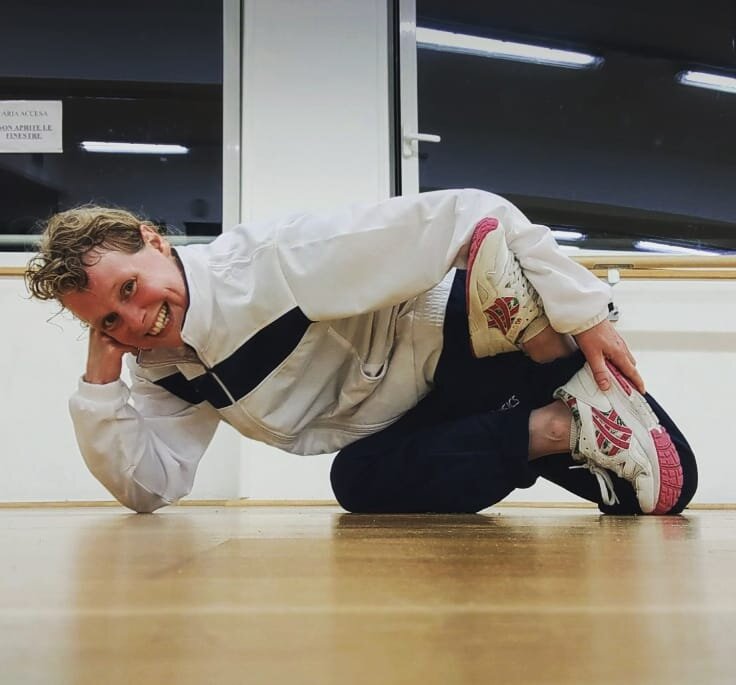
How I put together an “Emma Flow”
Some thoughts on how I put together an “Emma Flow”

How I create an “Emma Flow”
My creative process
Since I started breaking in 1997, I have always taken notes. Moves I learn at workshops, feedback, thoughts and ideas, sets, combos (combinations). During a 6 day course I did with Ken Swift in London (Pioneers at Sadlers Wells), I took so many notes that they filled 20 typed pages. One of those days he talked about categorising your moves eg spin moves, air moves, drops, freezes, footwork. Then when you go training you can do things like choose moves from a category to practice. It’s a way to plan and organise your training sessions. I started categorising my moves after that.
Using your categories, one way to put together a set or a combo is choose a move from each category, for example:
A drop
A footwork step
A transition to your back
A backrock
An air move or spin move
A freeze
A get up