

Moving the Goalposts Task
Rehearsal footage from Second Guessing, a Hip Hop Theatre work that investigates the theme of coercive control. This trailer highlights the effects that the abuser's tactics of moving the goalposts have on the victim. Video by sara_tamburro_videoeditor

During my two weeks of rehearsal at Centro la Fenice in Modena, Italy, I worked on two movement tasks, Intimidation and Moving the Goalposts. You can read about my thoughts behind the intimidation task here: https://www.emmaready.one/secondguessingblog/intimidation
“Fear and confusion are central to our understanding of coercive control; it is living in a world of moving goal-posts, shifting sand; it is like constantly walking on eggshells. It is a world of everyday terror.”
https://www.cedarnetwork.org.uk/about/what-cedar-achieves/what-is-coercive-control/
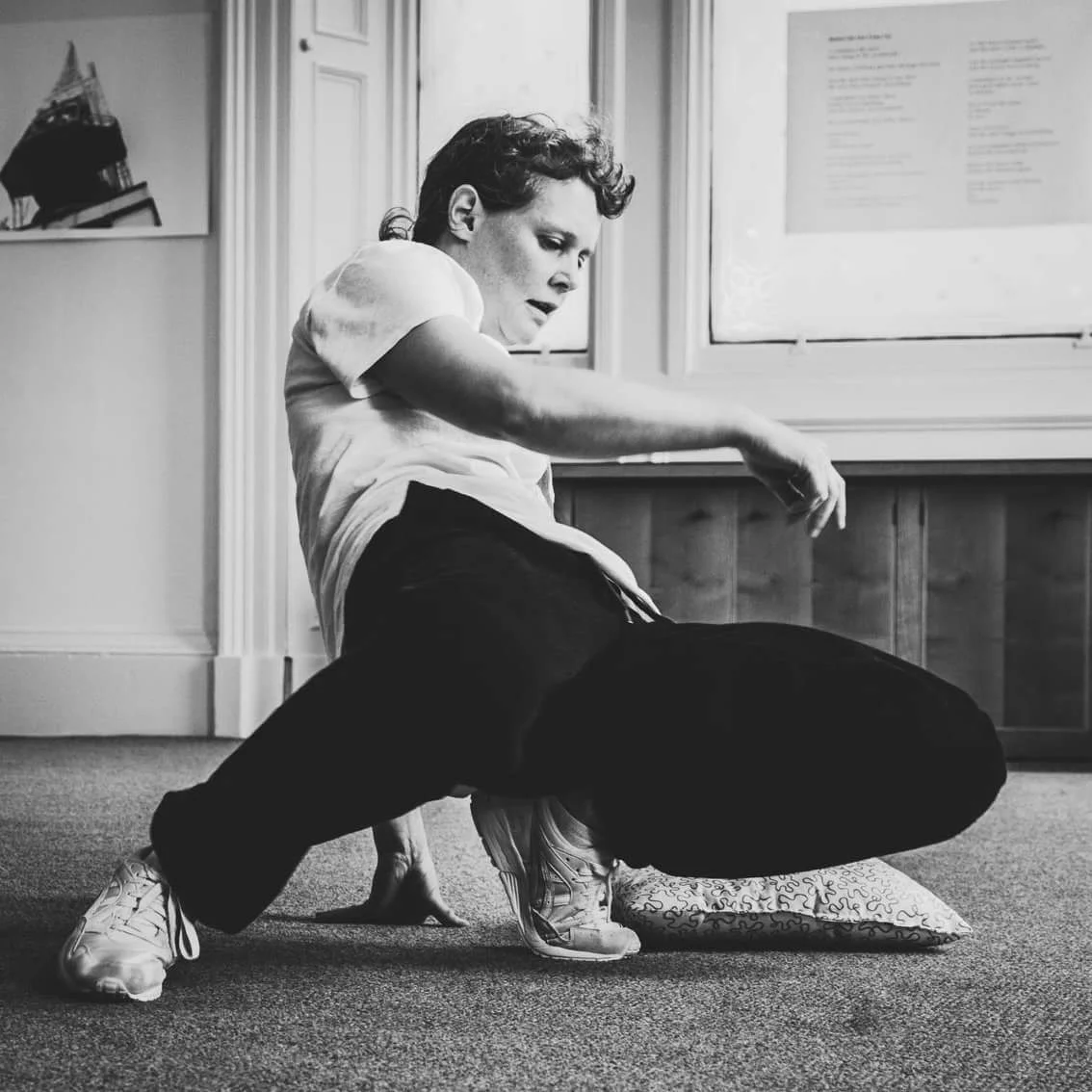
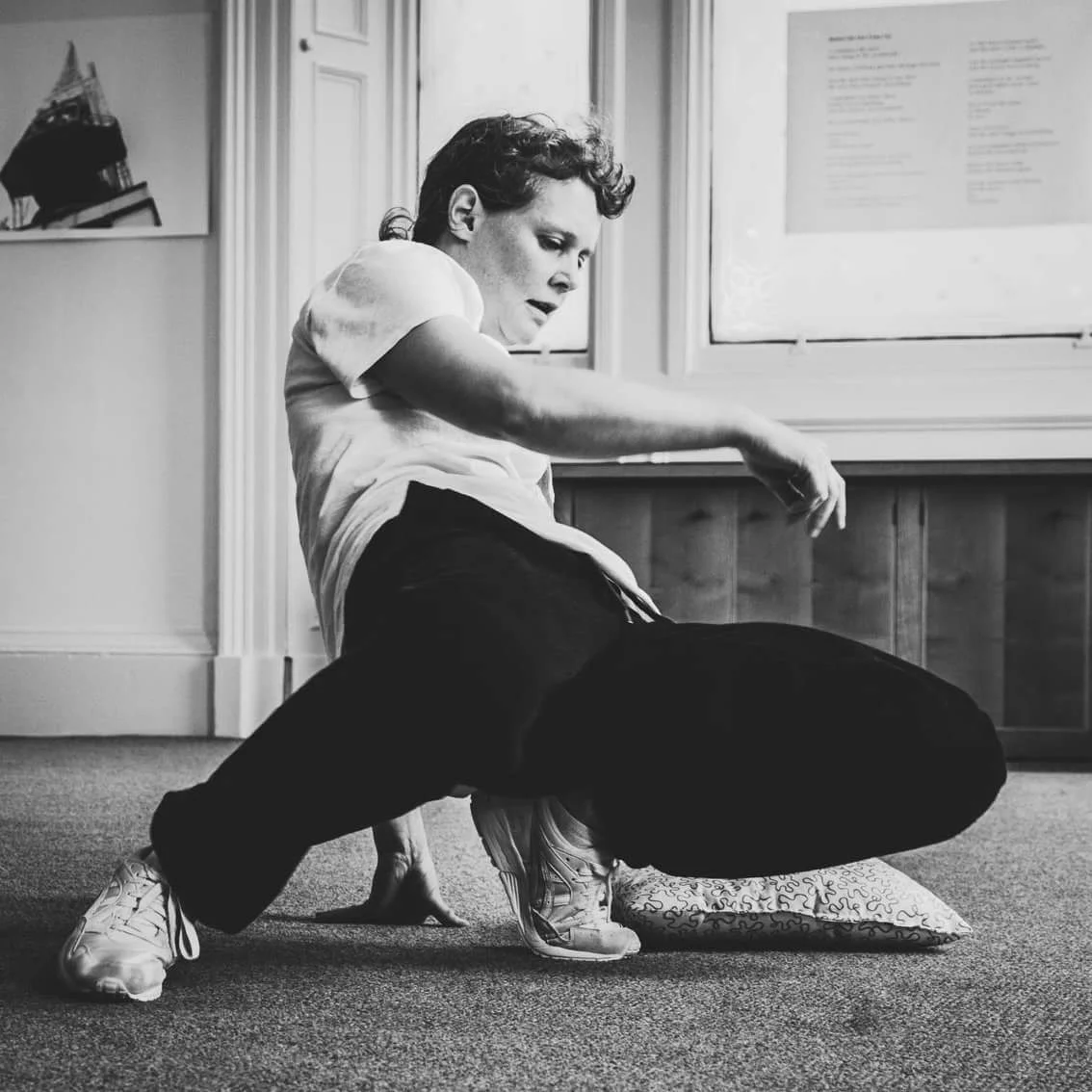
For the Moving the Goalposts task, I extended the work I had begun in June 2018 when I took part in a one day residency as part of Leith Festival at Custom House, Leith. One way the abuser moves the goalposts is by imposing and enforcing a set of rules that are particular to the victim. Once the victim feels they know the rules, the abuser will change them without warning. Changing the rules, or moving the goalposts, is a tactic used by the abuser to keep the victim on edge, hypervigilant and walking on eggshells. I explored these tactics in a physical manner, using cushions as ‘goalposts’. I started by travelling with a pattern of movement towards one cushion, then to the other. I would end up kicking a cushion so it moved to another part of the space, and I would have to change direction in order to reach it the next time. This meant that the movement also had to stretch or shrink, and as I randomly kicked the cushion, I never knew where I would have to go next. This led to me becoming tired and disoriented, mirroring the emotional effects moving the goalposts has on victims.
In Italy, I replicated this task without using cushions as props. I devised a new pattern of movement and tried to take it into different areas of the space. It was more difficult to imagine where the cushions would be, which I thought would add to the feel of confusion as I danced. When I performed this task with the cushions, the movement naturally changed as I chased the ‘goalposts’, without the cushions I had to imagine how the movement would change. I found this more difficult and struggled to create something that made sense. I think I was also too focused on the details of the movement which precluded me from exploring and expressing the emotions of the task. I decided to rethink this task and do some more research before beginning the next block of rehearsals.

Intimidation Task
“Domestic abuse isn’t always physical. Coercive control is an act or a pattern of acts of assault, threats, humiliation and intimidation or other abuse that is used to harm, punish, or frighten their victim.”
https://www.womensaid.org.uk/information-support/what-is-domestic-abuse/coercive-control/

Video by sara_tamburro_videoeditor
“Domestic abuse isn’t always physical. Coercive control is an act or a pattern of acts of assault, threats, humiliation and intimidation or other abuse that is used to harm, punish, or frighten their victim.”
https://www.womensaid.org.uk/information-support/what-is-domestic-abuse/coercive-control/
In May this year I spent two weeks in rehearsal at Centro La Fenice in Modena, Italy, for my new Hip Hop Theatre work investigating coercive control, Second Guessing. This was the first of three rehearsal blocks I am undertaking as part of my research and development.
My research for this piece centres on:
Coercive Control and Trauma Informed Practice
Evan Stark describes coercive control as a pattern of behaviour which seeks to entrap women and take away their liberty. During the project I will attend trauma informed practice training.
Kinesthetic Empathy
“...the ability to experience empathy merely by observing the movements of another human being.” (Dee Reynolds, Matthew Reason, Kinesthetic Empathy in Creative and Cultural Practices)
Dynamics in Choreography
Dynamics involves scales of movement qualities, each invoking different emotional responses.
I am a bgirl (breakdancer) and applying this research to my choreography will enable me to be expressive beyond the physicality of breaking movement. Breaking is seen as an aggressive danceform, I want to demonstrate that breaking can express a range of emotions.
One of the choreography tasks I set myself in Modena was Intimidation. In his book, Coercive Control: How Men Entrap Women in Personal Life, Evan Stark describes intimidation as:
“Intimidation, the second major technology used in coercive control, instills fear, secrecy, dependence, compliance, loyalty and shame. Offenders induce these effects in three ways primarily - through threats, surveillance, and degradation. Intimidation relies heavily on what a woman’s past experience tells her a partner is likely to do and what she imagines he might do or is capable of doing.” (p249)
He compares the behaviour of abusers to that of captors of prisoners of war (POW):
“Offenders intimidate victims through many of the same tactics used to extract information or compliance from POWs, withholding or rationing food, money, clothes, medicine, or other things on which a woman depends.” (p253)
To create choreography that communicates to the audience the effects that intimidation tactics have on victims of coercive control, I took inspiration from Jean Newlove and John Dalby’s book Laban for All. In chapter 2 They explain Laban’s Dimensional Scale, also known as the Defence Scale as it encompasses six positions that a person can implement to defend the six most vulnerable parts of the body and head. I learned these movements and adapted them to become defence of the senses: sight, hearing, taste and touch. The adapted movements physically symbolise the victim’s psychological protection from the abuser’s intimidation tactics.
Sight - covering the eyes from piercing looks, gestures or the abuser getting in the victim’s face.
“In settings like the hospital where the risk that openly aggressive behaviour will expose abuse, offenders often rely on these invisible threats, giving signs of disapproval such as a raised eyebrow or clenched fist only seen by the victim or signaling control in ways providers interpret as solicitous…” (Evan Stark, p250)
Hearing - covering the ears from shouting, interrogation, threats, incessant phone calls.
“A client was expected to answer her cell phone promptly whenever and wherever her husband called, or he would subject her to an evening of cursing and screaming. To test her loyalty, he would call her while she was riding to work on her bike, causing several accidents, one in which she broke her arm.” (Evan Stark, p258)
Taste - the abuser may restrict or control what or when a victim eats.
“Donna chose to deprive herself of meals to meet Frank’s demands for economy, Terry Taficonda was limited to cold pizza during the final week of her life, and the husband in another case left his wife tied up in the basement for several days without food or water.” (Evan Stark, p273)
Touch - “In coercive control, the idea of physical harm planted in the victim’s mind can have more devastating effects than actual violence.” (Evan Stark, p251)
Each movement is connected to the next throughout the phrase, one part of my body is always in contact with another, and I make use of a breaking technique called threading. Threading is where you make a loop with two parts of your body and pass another part of your body through that loop, for example I touch my right shoulder with my left hand then pass my head through the loop of my left arm.
Once I prepared the movement phrase, I applied Laban’s theory of ‘efforts’ to it. Rudolf Laban is considered a pioneer of modern dance. His theory of efforts provides a model for understanding the quality of body movement. Eight efforts describe the ways dancers can move: Direct-Indirect, Light-Heavy, Sudden-Sustained and Bound-Free. Dancers can take the quickest route to their destination, or a meandering one; use heavy or light movements; tense or loose movements; move suddenly or take their time.
In this phrase, and perhaps throughout the piece, movement will start free, light, sustained and indirect, and gradually become more bound, heavy, sudden and direct. As this happens, the movement will become smaller and take up less space. In the study Finding the Costs of Freedom: How Women and Children Rebuild their Lives After Domestic Violence, Professor Liz Kelly et al state that:
“The impact of living in an abusive household gender regime is that women (and children) adapt their behaviour to cope
Their thinking and actions are narrowed, as they attempt to live and be his version of who they should be
If interventions are not appropriate the web tightens
It becomes harder and harder to imagine life outside of this control, what it is to have freedom of thought and action
We call this limiting space for action”
Limiting space for action is a theme that will recur throughout the piece, with movement becoming squashed, tense and small. There will be a gradual, insidious build up to the frantic climax of the intimidation section seen at the end of the trailer. This gradual build up is inspired by the fable of putting a frog in boiling water: if you put a frog into boiling water it will jump out, but if you put it in tepid water and slowly bring it to the boil it will not perceive the danger and will be cooked to death.
In my next rehearsal blocks I will begin work on the tasks Gaslighting and Manipulation:
“Gaslighting you – distorting the reality to upend and manipulate you”
https://www.laurarichards.co.uk/what-are-the-signs-of-coercive-control/
Rules and Regulations:
“Rules and Regulation – setting the rules to live by (just applies to you and not them), dinner on the table at a certain time, dress a certain way, hair a certain way, micro management of your life”
https://www.laurarichards.co.uk/what-are-the-signs-of-coercive-control/
Isolation:
“Isolation – controlling who you can speak to, monitoring you online and/or offline, checking up on you, monopolising your time, creating drama when you want to go out preventing you from making your own choices about when you go out, preventing access to transport and limiting your time with others.”
https://www.laurarichards.co.uk/what-are-the-signs-of-coercive-control/
References
Kelly, L, Sharp,N. and Klein, R., Finding the Costs of Freedom: How Women and Children Rebuild their Lives After Domestic Violence,
Newlove, J. and Dalby, J. (2004), Laban for All, Nick Hern (London)
Reynolds, D. and Reason, M. (2012), Kinesthetic Empathy in Creative and Cultural Practices, Intellect Book
Richards, L. (2019), What are the Signs of Coercive Control?
https://www.laurarichards.co.uk/what-are-the-signs-of-coercive-control/
Stark, E. (2007), Coercive Control: How Men Entrap Women in Personal Lie, Oxford University Press (USA)
Women’s Aid, What is Coercive Control?
https://www.womensaid.org.uk/information-support/what-is-domestic-abuse/coercive-control/
Persevere Exhibition and Residency at Custom House 2018
This residency was the first opportunity I had to practically explore the theoretical ideas I have been developing for my next piece of work, a solo Hip Hop dance theatre performance dealing with the theme of coercive control. Using the research I have been doing into coercive control, I have devised practical tasks based around this theme in order to develop movement phrases.
Photography by Deborah Mullen
This residency was the first opportunity I had to practically explore the theoretical ideas I have been developing for my next piece of work, a solo Hip Hop dance theatre performance dealing with the theme of coercive control. Using the research I have been doing into coercive control, I have devised practical tasks based around this theme in order to develop movement phrases. This paired well with the theme of the residency, “Persevere”, as statistics show that women will leave an abusive relationship an average of 7 times before leaving for good, and that this stage of leaving is the most dangerous point in the relationship. Coercive control is a pattern of behaviour which seeks to take away the victim’s freedom and sense of self through demands, threats and surveillance. Tactics used by perpetrators include:
Moving the goalposts
Changing the rules
Gaslighting
Limiting space for action
Gaslighting is defined as intentional twisting of perception of reality, making the victim question and doubt their sanity. Perpetrators of coercive control have their own set of rules that are unknown to the victim, which they enforce and change without warning. Once the victim feels they know the rules, the perpetrator will change them, without notice. Moving the goalposts is a way of keeping the victim confused and walking on eggshells. Limiting space for action is another tactic which aims to make the victim’s world smaller, by limiting freedom to say and do things and to meet their own needs without worry or fear. I explored these tactics in a physical manner, using cushions that were in the space as ‘goalposts’. I devised a pattern of movement, and repeated this with the ‘goalposts’ getting in the way, my space for action was limited. I played with this movement until I felt like it came to a natural end, then I devised another pattern of movement that was more complicated and physically more difficult. Although it seemed like I was starting from the beginning with the second pattern, with the cushions being in almost the same position, I was actually restarting from a place of disadvantage: I was already tired, disoriented and what I had to do now was much more difficult.
As I proceeded, the movement changed, as well as the pattern. No matter how hard I tried to keep to the pattern, I could not, and I could not predict when it would have to change. I was following the cushions, second guessing where they would land and always watching what I was doing. In this way, my movement complied with the location of the cushions.
Having the space and the time to explore these tasks was invaluable to the development of my piece. As a result of this residency I have many more ideas on how to proceed.